Introducing Carleton’s New School of Nursing
How Artificial Intelligence and Simulation Education Can Revolutionize Patient Care
When Carleton University welcomed the first cohort of students into its new Bachelor of Science in Nursing program in September 2025, it marked a significant moment for healthcare in the province. The program is the first new university nursing program in Canada in more than 20 years, and it comes at a time when our healthcare system is dealing with severe staffing shortages and intense capacity pressures.
Led by Danielle Manley, Director of the School of Nursing, Carleton’s new program was created with the future of healthcare in mind.
The program is designed to prepare nurses for a rapidly changing healthcare system, which means integrating artificial intelligence (AI), data science, mental health and resilience and simulation-based training into the program’s foundation.
Manley brings a diverse background to her new role. A Registered Nurse by trade, she worked across a range of clinical areas before discovering her passion for education. During her time onboarding new staff, designing clinical programs, and supporting patients through education, she became interested in electronic medical records and how data is collected, managed, and used across our healthcare system.
This interest led her to the field of clinical informatics: the application of data science within healthcare to improve patient care and outcomes. After pursuing graduate studies in education, she landed at Carleton just in time to design the program from the ground up.
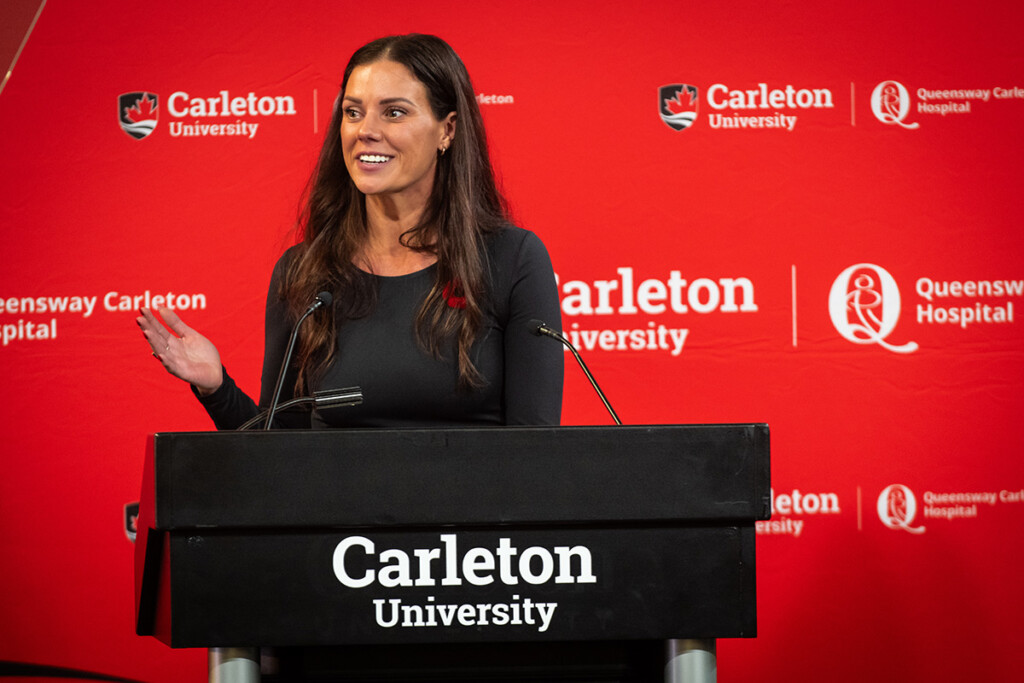
Danielle Manley speaks at School of Nursing launch event in 2024
Carleton’s nursing program was made possible through a collaboration between the Faculty of Science and Ottawa’s Queensway Carleton Hospital. Once the partnership was established, Manley took the lead in turning that vision into a fully operational School of Nursing.
The first cohort of around 100 nursing students began their studies this past fall.
An Accelerated, Student-Centered Program
Carleton’s nursing program is delivered over three years across nine semesters, including during summer months. This structure is ideal for students who are eager to transition quickly from academic life into a full-time nursing career post-grad.
The program was developed using student input and feedback, including from those who have studied in other nursing programs. Many emphasized the importance of early clinical exposure to confirm that nursing was the right career path. As a result, Carleton’s program introduces hands-on learning in the first year.
Students can choose to concentrate their studies in one of two areas: Data Science or Neuroscience and Mental Health. Graduates in the neuroscience concentration will be eligible to register as Psychotherapists in addition to Registered Nurses. The data science concentration is ideal for students interested in designing healthcare systems and developing hospital software.
An additional standout feature of the program is RN Prescribing, which is embedded throughout the undergraduate program. Every Carleton nursing student will graduate with the competencies to assess, select, and prescribe approved therapies within the Registered Nurse scope of practice. This makes Carleton the first in the world to graduate all students as RN Prescribers in its undergraduate nursing degree.
Integrating AI into Nursing
A unique feature of Carleton’s nursing program is the integration of AI and data science into the curriculum. Manley says students will play a central role in shaping how these tools are used responsibly in the future.
“The future of healthcare relies on an innovative approach,” says Manley.
She points out that administrative burdens, like charting, are an area that AI can support to make room for patient care. While the use of AI in healthcare raises ethical considerations, Manley has extensive experience using it in practice to educate healthcare providers and faculty. She notes that open-source models most people are familiar with, like ChatGPT, draw from vast sources. AI systems used in healthcare are designed to reduce bias while supporting clinical decision-making.
Learning Through Simulation
Simulation-based education is another fundamental aspect of the program. Assistant Professor and Associate Director (Simulation) Jennifer Dale-Tam brings more than 25 years of experience in nursing, 15 years in health profession’s education and a decade of simulation-based training experience to the role.
Dale-Tam explains that simulation-based education is a form of problem-based learning. Using simulation manikins, virtual reality, and numerous other modalities students can work through realistic clinical scenarios while being guided toward specific learning outcomes.
“I love to see the aha moment in students when something suddenly clicks for them and they realize they can do it,” says Dale-Tam.
Carleton’s newest building, the Clinical Skills and Simulation Centre in Ottawa’s Kanata Tech Park opened in January. The space welcomes students into a state-of-the-art facility created to support safe, realistic learning. At the Centre, first-year students can build foundational nursing skills like taking vital signs, administering oxygen through nasal cannulas, and performing health assessments before they enter high-stakes clinical environments.
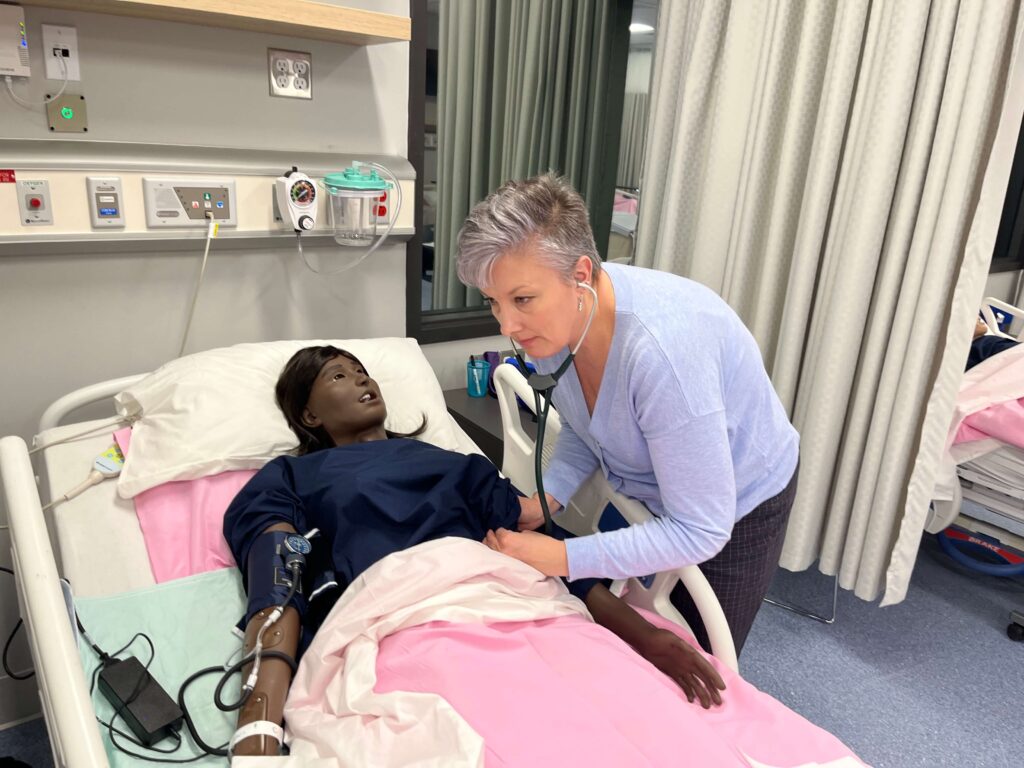
“Simulation-based education is student centric which means we help create a psychologically safe space for students to take risks,” says Dale-Tam. “Building trust with our learners helps them push themselves to reach their highest potential.”
Shaping the Future of Healthcare with Carleton Nursing
Both Manley and Dale-Tam emphasize that being a part of one of Carleton’s first School of Nursing cohorts of comes with unique opportunities. Student feedback will continue to play a role in shaping the program’s evolution.
“We memorized our students’ names before they came. They will be the first new grads of the new nursing program,” says Manley. “Their names will mean a lot because they are creating this with us.”
Manley intends for the program to prepare graduates who are resilient and empowered leaders.
“I can’t think of a better place than the Kanata Tech Park to train nurses who are technology-focused and are equipped with the resources to make the changes our healthcare system needs,” she says.
For prospective students, both Manley and Dale-Tam are candid about the challenges and rewards of pursuing nursing as a profession.
“Nursing doesn’t just change you. It reshapes the way you see the world,” says Manley. It hardens you in some ways, softens you in others, and once it’s a part of you, there’s no going back.”
Want to shape the future of healthcare? Learn more about Carleton’s Bachelor of Science in Nursing today.